The World Is Not Waiting for America
A week in Hyderabad showed me a city growing faster than its streets can hold. It also changed the questions I ask about how America treats talent, growth, and its own future.
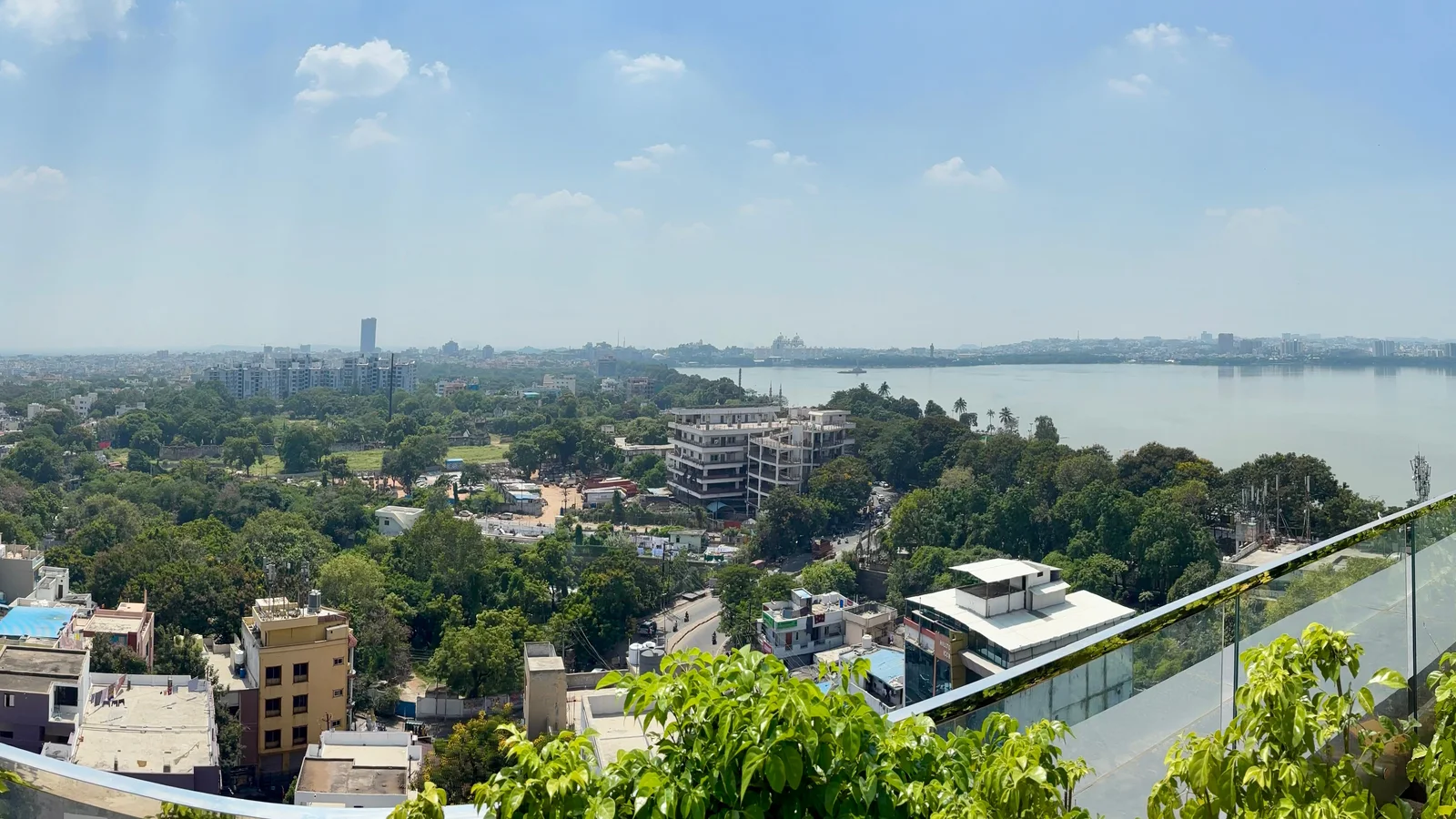
The first thing I noticed in Hyderabad was the streets. Cars, motorcycles, auto rickshaws, and pedestrians negotiated space in ways I couldn’t begin to predict. As an American used to traffic lanes and settled rules about who moves when, I kept trying to impose an order on what I was seeing. Hyderabad wasn’t especially interested in my expectations.
It took me a few days to see past the disorder to what was driving it. People were going somewhere, doing something, making a living, trying to get ahead. What looked like chaos from the back seat of a car was demand pressing against capacity: a city being asked to absorb more growth than its streets could comfortably hold. America has largely forgotten what growth at that pace looks and feels like.

Evening traffic in Hyderabad. The auto rickshaw is selling land plots and a commerce degree.
I went to Hyderabad for work, to spend time with colleagues whose professional lives connect India and the United States, many of them in the technology sector that has made the city one of the most consequential places in the global economy. I also visited temples, walked the streets, and climbed through Golconda Fort. A week in one city offers no sweeping explanation of a country as large and complex as India. But it made me reconsider how casually Americans assume the rest of the world will keep organizing itself around us.
Much of the United States lives with the challenges of maturity. Our communities are responsible for roads, water systems, schools, and public buildings constructed by earlier generations. In Mt. Lebanon, where I serve as a commissioner, the cost of renewing what those generations built has been arriving for years and is still growing, even as a new generation of residents asks new things of the community. Much of our public conversation is about what we can afford to keep.
Maintaining what we inherited is part of our responsibility to the people who come after us. But it can narrow our imagination. When so much of public life is spent managing yesterday’s investments, it is easy to forget the intensity of building tomorrow’s.
Hyderabad brought that distinction into focus. Last week the World Bank raised its forecast for India’s growth in the 2026-27 fiscal year to 7.1 percent. On paper, that is a statistic. On the streets, it was visible: people moving between old and new ways of life, and the friction of an economy changing faster than its surroundings can adjust.
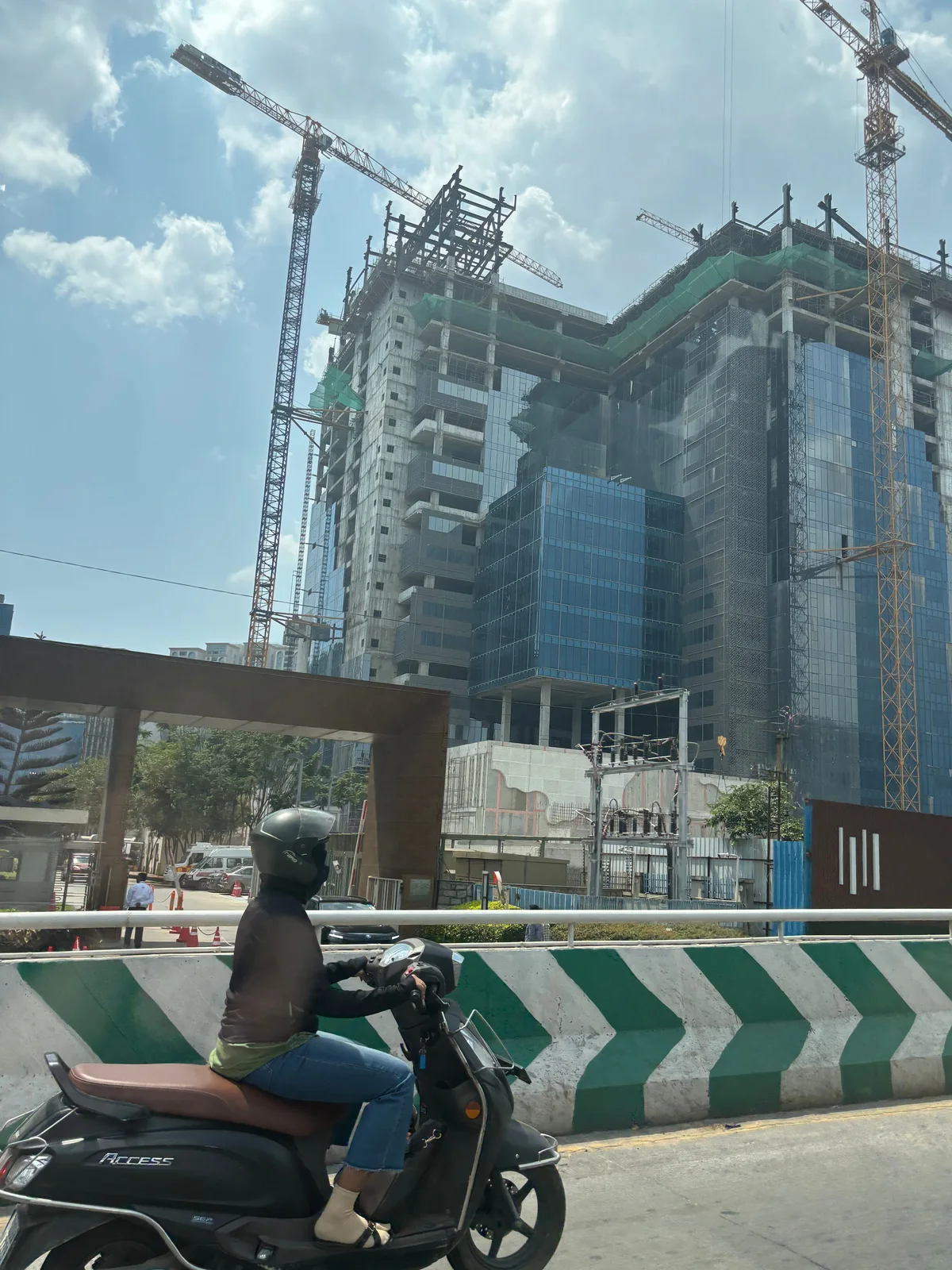
A new tower rises in Hyderabad while the city keeps moving past it.
That friction has real costs. Congestion takes time and money from people who can least afford to lose either, and national growth figures can conceal deep inequality. A business traveler cannot understand the daily burdens of the people who live with those conditions, and I won’t pretend to. But the same scene that revealed the costs of inadequate capacity also revealed extraordinary demand for a better future, and that ambition deserves to be seen for what it is, even when it arrives in an unfamiliar form.
Golconda Fort and the temples I visited were reminders of how much history sits alongside contemporary ambition. Americans tend to receive India in fragments: an ancient civilization, a country with widespread poverty, a destination for outsourced work, a rising technology power. Each holds some truth, and together they still leave a remarkably incomplete picture. What I saw was a society that has not had to choose between its historical identity and full participation in the modern global economy.
We often speak as though modernization means becoming more like America. Other societies are not simply at earlier points along a path we have already traveled. They have histories, expectations, and futures of their own.
For decades, American discussion of India’s technology industry relied on the language of outsourcing: important decisions happened here, lower-cost work happened there. That description no longer fits. Hyderabad now hosts roughly 515 global capability centers, the in-house engineering, research, and operations hubs that multinational companies run for themselves. Together they employ more than 300,000 people, according to a 2026 report from FICCI and Anarock, about a fifth of all such centers in India.
Cost differences still matter, and not every center does the same work. But many now design products, build systems, and solve problems that shape companies around the world. The people doing that work are helping invent the future directly. Visiting Hyderabad put faces and conversations behind a shift I had previously known mostly through reports and business plans.
Which is why our current debate over skilled immigration looks so shortsighted from there. The Trump administration has moved to restrict the H-1B program, most visibly through a $100,000 payment requirement for certain new petitions involving workers outside the United States. A federal court struck down the policies implementing that requirement in June, but the administration extended it last month through September 2027 and is fighting the ruling. Whatever the courts decide, the signal has already been sent, and companies plan around uncertainty as surely as they plan around cost.
The administration argues that the program has been misused to displace American workers and suppress wages, and it reports evidence that the policy is changing behavior: registrations from the largest IT staffing and outsourcing firms have fallen 92 percent, with more applications now for workers with advanced degrees and higher-paying offers. If those numbers hold, the policy is reaching some of the abuse it targeted, and that deserves to be taken seriously. But the cost does not fall only on the firms that gamed the system. It also falls on employers who wanted to bring talent here.
Protecting American workers and discouraging American investment are not the same thing. A company that needs engineers or researchers has three choices: hire and train Americans, bring talented people from abroad to work here, or build a team somewhere like Hyderabad. Making the second option harder does not eliminate the third. Reuters reported last year that the visa crackdown was pushing American companies to consider moving more sophisticated work to India. India’s technology sector was growing long before this administration, and visa policy is not the main reason for it. But it is a consequence policymakers cannot responsibly ignore.
Consider what moves when a company places a product team overseas. Expertise accumulates there. Managers gain experience. Professional networks deepen. New ideas emerge from people working together, and eventually new companies grow out of those networks. Where today’s work happens shapes where tomorrow’s opportunity appears. If our policies make it harder for talented people to build their lives here, we should not assume their talent, or the economic activity that follows it, will stay put waiting for us.
None of this makes India’s success a loss for America. A growing Indian economy creates opportunities for American companies and workers, and people in the two countries build things together that neither could build as well alone. But cooperation is not the absence of competition. Other countries are developing the capacity to make consequential decisions without waiting for American institutions to lead. Our great advantage was that people from everywhere could bring their ambitions here and build something new. That advantage is real, but it is not self-sustaining.
In local government, I have often argued that our responsibility is not to preserve every inherited arrangement exactly as we found it. It is to maintain what works, repair what doesn’t, and build the capacity the next generation will need. The same principle should guide our national economic choices. Protecting people from the costs of change is necessary. Protecting ourselves from the possibility of change is not a strategy for prosperity.
When I think about Hyderabad now, I still see the streets, and I remember how quickly my instinct was to look for the rules that ought to have organized them. I also remember the people I met and a city intensely engaged with its future. Those impressions don’t add up to a verdict on India, but they have changed the questions I ask about home. What would it look like for America to approach the future confident that there is more to build than to defend? What would our debates sound like if we treated new talent, new technologies, and new economic relationships as ways to strengthen our capacity, rather than threats to our position?
Hyderabad reminded me that growth is rarely orderly, that ambition doesn’t always look familiar, and that innovation doesn’t need an American address. The world is moving, sometimes with an energy that looks like chaos from the outside. It is not waiting for us. The question is whether we will keep building alongside it.
Andrew Flynn is a Commissioner in Mt. Lebanon, Pennsylvania, a municipal advisor working in public finance, and a volunteer firefighter and EMT. He writes about whether public institutions can still do what we ask of them. More about Andrew.